
How to Use Yila to Simulate Peer Review and Identify Rejection Risks Before Submission
A practical guide to using Yila for pre-submission mock peer review, from defining reviewer standards and review lenses to identifying rejection risks and prioritizing revisions.

Before submission, the hardest problems to spot are rarely typos. They are the issues that make reviewers question the value and credibility of a paper: Is the novelty clear enough? Can the study design support the conclusions? Has the evidence been overinterpreted? Is the manuscript appropriate for the target journal's readership?
Yila's Mock Peer Review pressure-tests a manuscript using realistic reviewer logic. It produces three reviewer-style reports covering contribution, methods, evidence, audience, and readability, then synthesizes their consensus, disagreements, and highest-priority revisions. It is designed for a systematic pre-submission review that exposes the issues most likely to lead to rejection or major revision.
In short, this is not merely language polishing. It asks the questions a reviewer would ask: Why does this paper deserve publication? Are the methods reliable? Are the conclusions adequately supported by the evidence?
1. What to Prepare
-
A complete manuscript or detailed summary: Upload a PDF or DOCX file, or paste the manuscript text. A summary can be reviewed, but conclusions about methods, statistics, and reproducibility will be limited.
-
Target journal or intended audience: For example, Nature Communications, a specialist SCI journal, or a Q3 materials science journal.
-
Priority review areas: Such as novelty, study design, statistical methods, the evidence chain, readability, or rejection risk.
-
Review strictness: Choose a constructive review, a tough journal review, or a rejection-risk audit.
2. How to Use Mock Peer Review
Step 1: Open the Playbook and Upload Your Manuscript
Open Mock Peer Review from Yila's Playbooks. Click the paperclip in the lower-left corner of the input box to upload your paper, or paste the manuscript, abstract, and core claims directly. Common research formats such as PDF, DOCX, TXT, and Markdown are supported.
On the Yila interface, the page title is “Mock Peer Review,” with the description “Pressure-test your manuscript across contribution, methods, evidence, and readability before submission.” After attaching the file and entering your requirements, click the arrow in the lower-right corner to begin.
Step 2: Define the Review Standard Clearly
Avoid entering only “Review my paper.” Specify the target journal, reviewer role, priority concerns, and expected output.
Example:
Review this manuscript using the standards of a Q3 SCI journal. Focus on novelty, methods and statistics, whether the evidence supports the conclusions, and fit with the target journal. Identify the three issues most likely to cause rejection, separate major comments from minor comments, and provide a prioritized revision plan. Every judgment must point to a specific passage or claim in the manuscript.
Step 3: Choose the Review Lens and Level of Strictness
-
Balanced pre-submission review: A comprehensive assessment of contribution, methods, evidence, audience, and presentation.
-
Novelty and significance: Focuses on the research gap, core contribution, and incremental value over prior work.
-
Methods and statistics: Examines study design, statistical validity, robustness, and reproducibility.
-
Clarity and readership: Reviews structure, argumentative flow, terminology, and fit with the intended audience.
If the paper is nearly ready for submission, choose Tough Journal Review or Reject-Risk Audit to expose the problems most likely to concern editors and reviewers.
Step 4: Follow the Review Process
Yila works through four stages:
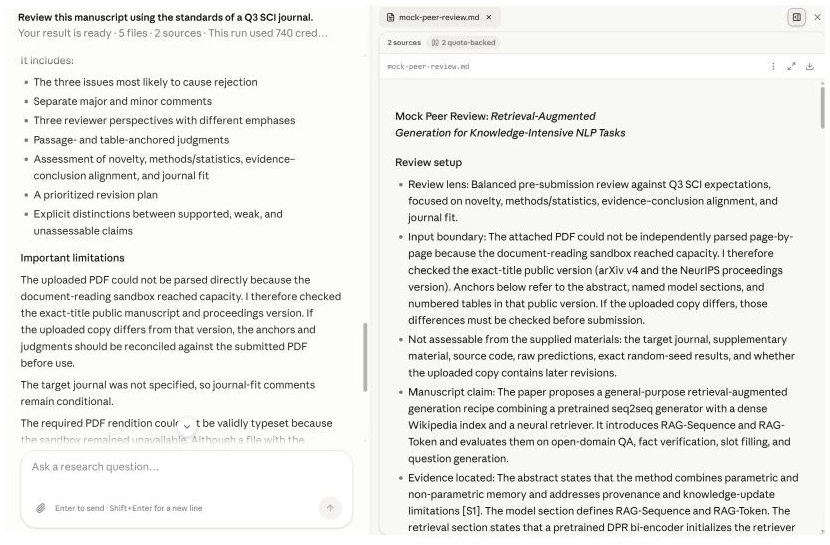
-
Build the fact base: Extract the manuscript's central claims, evidence, boundaries, and missing materials.
-
Assess contribution and audience: Evaluate novelty, significance, readership, clarity, and journal fit.
-
Assess methods and evidence: Examine technical soundness, statistics, reproducibility, and support for each key claim.
-
Synthesize risks: Consolidate shared strengths, technical risks, unsupported claims, and revision priorities across the three reviewer perspectives.
The process is estimated to take approximately 12 minutes. Actual time depends on manuscript length, the number of attachments, and the requested review depth.
Step 5: Read and Use the Review Package
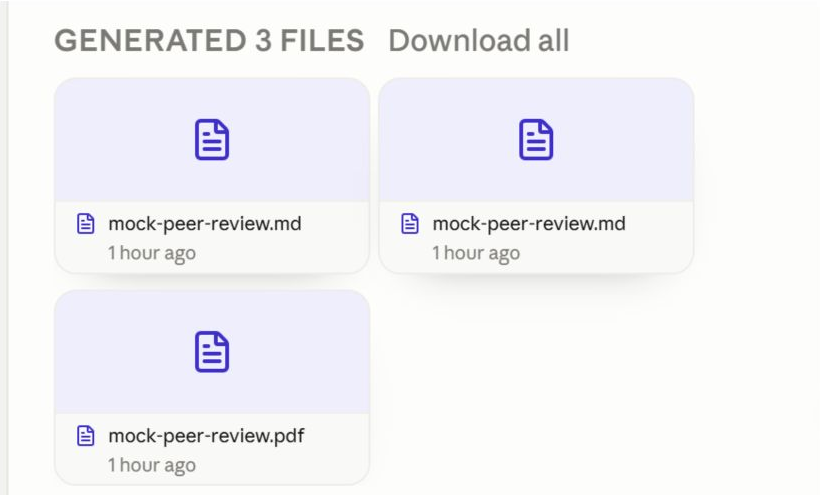
Yila produces two versions of the report:
-
mock-peer-review.md — easy to edit, copy, and continue revising with Yila.
-
mock-peer-review.pdf — suitable for downloading, sharing, and archiving.
Review the overall recommendation and rejection risks first. Then address major comments, especially issues involving methods, evidence, and the central contribution. Handle minor comments and language issues afterward. Once revisions are complete, run another review and compare whether the high-risk issues have been reduced.
3. Ready-to-Use Prompts
Comprehensive Pre-submission Review
Act as three independent reviewers: one focused on novelty and journal fit, one on methods and statistics, and one on the evidence chain and readability. Provide separate major and minor comments, then synthesize the reviewers' consensus, disagreements, overall recommendation, and a prioritized revision plan. Ground every judgment in specific manuscript content. Do not fabricate data or experimental results.
Rejection-Risk Audit
Apply a strict journal-review standard and identify the five issues most likely to lead to rejection during editorial screening or external review. For each issue, explain what the problem is, where the supporting evidence appears in the manuscript, why it is serious, the smallest viable correction, and the likely consequence if it remains unresolved.
Methods and Statistics Review
Focus on study design, samples and controls, variable definitions, statistical tests, ablation or robustness analyses, reproducibility, and the boundaries of claim generalization. Separate blocking issues from non-blocking improvements. Do not assume access to raw data that has not been provided.
Target-Journal Fit Review
The target journal is [journal name]. Based on its readership and typical article positioning, assess whether the manuscript's novelty, significance, technical depth, and presentation are a good fit. Identify the abstract, introduction, results, or discussion sections that most need revision before submission.
4. How to Obtain More Reliable Results
-
Upload the complete manuscript whenever possible.
-
Identify the exact manuscript version to be reviewed.
-
Provide the target journal and article type.
-
Ask every major comment to cite a page, section, figure, table, or specific claim.
-
Fix structural problems before language polishing.
-
Use multiple rounds: begin with a general rejection-risk audit, then run a focused methods or novelty review.
5. How to Interpret the Results
Mock Peer Review is intended to identify problems and establish revision priorities; it does not predict acceptance. Yila bases its judgments only on the supplied materials and, when necessary, verifiable background information. It does not claim access to unprovided raw data or invent experiments or statistical results.
Real peer review is also influenced by journal scope, editorial judgment, reviewer expertise, and disciplinary debate. Treat the report as a rigorous pre-submission stress test, and retain final academic judgment as the author.
6. Frequently Asked Questions
Can I use only an abstract?
Yes, but the output will be most useful for assessing topic selection, contribution framing, and basic logic. It cannot replace a full review of methods, statistics, figures, and reproducibility.
Can I specify an SCI quartile or reviewer style?
Yes. State the discipline, target journal or quartile, strictness level, and dimensions you want the reviewers to prioritize.
Will the report revise my manuscript directly?
The Playbook first delivers reviewer comments and a revision priority list. You can then ask Yila to revise a passage in response to a major comment, or continue with manuscript polishing or a reviewer-response workflow.
What if the three reviewers disagree?
Prioritize issues raised by multiple reviewers. For disagreements, compare the evidence, intended readership, and review lens behind each position before deciding on a submission strategy.
Will my manuscript be stored or used for other purposes?
The manuscript is processed only to complete the analysis and deliverables requested in the current task. Yila does not publish your manuscript as public content, use the manuscript text as model-training material, or create a persistent paper repository searchable by other users. Processing is limited to what is necessary for file parsing, peer-review generation, and result delivery, with access controls used to restrict unauthorized access. For unpublished manuscripts, patent-sensitive work, trade secrets, or sensitive research data, you should still follow your institution's data-management, confidentiality, and compliance requirements and, where appropriate, remove or anonymize sensitive information before uploading.
7. Recommended End-to-End Workflow
Complete the manuscript draft → Run a rejection-risk audit with Mock Peer Review → Revise the major comments → Run a focused methods or novelty review → Polish the language → Use a pre-submission completeness check against the journal requirements → Submit.
For a test run, upload Retrieval-Augmented Generation for Knowledge-Intensive NLP Tasks.pdf and use the “Comprehensive Pre-submission Review” prompt above